Showing posts with label Urban collective memories. Show all posts

Sunday, August 3, 2025

On Personal Belongings After a Catastrophe


Musical homage and offerings to a dead musician. Santa Ana, CA, November 2024. Photo by Myriam Mahiques 

1.     Receptiveness

Psychology and sociology continuously refer to objects from a technological perspective which is not related to individuals or the collective discourse.

In his book The System of Objects, sociologist Jean Baudrillard adds the (social) imaginary as a a dimension linked to the object: “The object as humble and receptive supporting actor, as a sort of psychological slave or confidant- the object as directly experienced in traditional daily life and illustrated throughout the history of Western art down to our own day. This object was the reflection of a total order, bound up with a well-defined conception of décor and perspective, substance and bound up with a well-defined conception of décor and perspective, substance and form. According to this conception, the form is an absolute dividing-line between inside and outside. Form is a rigid container, and within it is substance. Beyond their practical function, therefore, objects – and specifically objects of furniture- have a primordial function as vessels, a function that belongs to the register of the imaginary. This explains their psychological receptiveness.” (Baudrillard, 2020). In this sense, personal belongings are not just “things”.

 Emotivity and Phenomenology 

Materiality is essentially physical. It shapes the objects, their fabrication technique, the traces left by time. Materiality is apprehended through our senses which differ according to the culture of communities. It is a concept that expands to the idea of “social” and foremost to the relationship between people and things.

Objects achieve a special strength with the feelings they are assigned to. It could be just a simple pencil which was part of an event; for social groups, it could be a procer’s relic. Offerings are left before statues and memorials, then objects are a bridge between the alive and the dead. 

The element of human perception, the understanding, the intangible part, would be the “atmosphere”. Philosopher Gernot Böhme defines “atmosphere” as a holistic, affective, and sensual quality of a space that mediates between the objective environment and the subjective experience of individuals:

“I have introduced the concept of atmosphere (…) to designate that which mediates the objective qualities of an environment with the bodily-sensual states of a person in this environment; the environment in its entirety generates an atmosphere in which I, as a human, feel in one way or another. (…) I sense in which environment I am located (…). The concept of atmosphere is, according to this etymology, a concept concerning the in-between (Zwischen): between objective conditions and subjective states, between object and subject.” (Böhme, 2014)

A pile of broken dishes on the ground

AI-generated content may be incorrect.

China and pottery remnants in Altadena after the wildfires. March 2025. Photo by Myriam Mahiques

In an approach to the sensory expression, the previous paragraphs are pertinent to the importance of our findings in Altadena. We have seen multiple objects of daily life with different degrees of deterioration. Pieces of folk-art stand out among cutlery, toys, décor. The Army Corps of Engineers’ contractors were working with heavy machinery, cleaning lots, and preparing the preliminary excavation for soils remediation. There was no possibility of selecting what would be of value for its repair, recycle or return to the owners. The intangible and emotional aspects were not included in the post-fire management protocol.


1.     Possible exhibition of objects


Objects have their own biographies. David Howes (2023) writes about the social force of objects: “It is not that this force needs to be “revivified,” though, just acknowledged: “When you see an object reconnect with its family, when they hold an old piece of beading or interact with a pipe, it is not the object which is being reanimated but the relationship which is being rekindled on both sides because of the materiality and sensory connection that happens between them.”

There is also an extrapolation of these objects’ meaning. For example, what was décor, and now is a ruin, could become a piece of exhibit in a museum. An example of this, would be the piece of melted glass from the San Francisco earthquake and fire (1906), donated by Grace Gratton Masterson to the Turtle Bay’s Collection in Redding. The piece is exhibited online and at the museum. In this context, the glass could be exposed due to its mineralogical conditions or because now it is part of the fire collective memory.


2.     Brief account from San Francisco history


A group of people in a destroyed area

AI-generated content may be incorrect.


Souvenirs hunters and homeowners looking for personal possession after the earthquake and fire in San Francisco, 1906.

Photo from the National Archives.


Charles Morris (1906) reports the desperation of people trying to save their household effects during the San Francisco earthquake and fire:

“In the awful scramble for safety the half-crazed survivors disregarded everything but the thought of themselves and their property. In every excavation and hole throughout the north beach householders buried household effects, throwing them into ditches and covering the holes. Attempts were made to mark the graves of the property so that it could be recovered after the flames were appeased.” It is interesting that he has used the word “graves” as if the objects had a life once. Implicitly, Morris has assigned to the households a higher level of importance.


3.     Objects from Altadena


A fenced in area with debris and a building

AI-generated content may be incorrect.

A shrine that must be in good condition in the aftermath of Altadena wildfire. March 2025. Photo by Myriam Mahiques

A person standing in a dirt area

AI-generated content may be incorrect.

Local art among the ruins of Altadena, March 2025. Photo by Myriam Mahiques


A person standing next to red chairs

AI-generated content may be incorrect.

The Installation “Recycled Words” at the Manitoba Museum was the work of KANVA, a group of young architects in Montreal. Curator Maureen Matthews proposed words on the chairs to provoke thoughts. 2015.

The installation shown above reminds us of the single chair “exposed” among the ruins of the wildfire in Altadena. This chair might have been on a porch.  We see it as a gloomy sculpture that carries a memory of the past life in this burnt house. 

A chair in a grassy field

AI-generated content may be incorrect.

A single chair on the new lawn after the rain. Altadena, March 2025. Photo by Myriam Mahiques. 

In Los Angeles wildfires of 2025, lots of individuals grappled with what they wanted to take with them; the difficult selection lasted just a few minutes. From Gillan Telling’s article “What They Grabbed in the L.A. Fires and Why: Tender Stories from Those Who Left Almost Everything Behind (January 12th, 2025), we cite Sloan Pechia’s story who, apart from a letter from her late grandmother, she carried a poem from a book: “I also took the poem “Imagine a Woman,” which was sent to me in a letter from my mom during my freshman year of college. Reading it and reminding myself that I’m strong is why I thought to take it during these incredibly trying times.”

A picture of a couple of women in a glass bowl

AI-generated content may be incorrect.

Valuable personal items that Sloan Pechia took with her during the wildfire evacuation.  Photos by Sloan Pechia.

This is not that everyone has the chance to survive a catastrophe. Regarding this, we recommend reading the work of the Lucy Easthope, a British expert and adviser on emergency planning and disaster recovery.  A great part of the management post-catastrophe is the removal of personal effects that may be returned to a bereaved family. “The item may have little or no monetary value but may mean everything to a grieving family; or to a survivor struggling to make sense of terrible events.” (Easthope, 2019). As we have seen in the Los Angeles wildfires, without an “ethic of care” from all responders, the personal effects are indiscriminately removed to landfill or even incinerated.

 “(…) response plans should therefore aim to prioritize personal effects with a principal aim to identify, locate and restore personal property in a timely and accurate manner that allows survivors and bereaved to make as many of their own choices as possible.” (Easthope, 2019).

It is recommended that strategies for devolution and restoration be devised to enable survivors to exercise decision-making authority over their valued possessions, which hold intrinsic and emotional significance. 

BIBLIOGRAPHY

Baudrillard, Jean. The System of Objects. London, 2020. 

Bohme, Gernot. The theory of atmospheres and its applications. Translated by A. Chr. Engels-Schwarzpaul. In Interstices Journal of Architecture and Related Arts. Issue 15. 2014-03-18

Easthope, Lucy. The meaning of “things”. The evolution of an ethic of care in the return of personal effects after disaster 2001-2019. P. 122-128. In Bereavement Journal.org. 2019.

Howes, David. Sensorial Investigations. A history of the senses in anthropology, psychology, and law. The Pennsylvania State University Press. 2023.

Morris, Charles. The San Francisco Calamity by Earthquake and Fire. Told by Eye Witnesses. Secaucus, N.J.: Citadel Press, ca. 1906.

Telling, Gillian. “What They Grabbed in the L.A. Fires and Why: Tender Stories from Those Who Left Almost Everything Behind”. People.com. January 12th, 2025.   

NOTE: this post is also published on AIA Los Angeles blog.

https://www.aialosangeles.org/news/news-and-blogs/

Sunday, November 10, 2024

Thoughts on "The Wall of Gazes" exhibited at the MOOLA


I had the real pleasure of visiting the current exhibition Arteonica at the Museum of Latin American Art in Long Beach, CA. There were the works of several artists, from Chile, Argentina, Mexico, Switzerland, Brazil. 

The work that impacted me the most was "Wall of Gazes" by Argentinians Mariano Sardón and (neuroscientist) Mariano Sigman. The videos, depicted as transforming portraits were mesmerizing. 


All portraits are superimposed images in videos, the algorithms keep on changing until the face is formed or partially formed. 

From Ars Electronica:

"The Wall of Gazes consists of one screen in which visitors can see how portrait images are revealed by the eye movements of many persons simultaneously. Gazes were captured by an eye tracker device. Around 100 participants were seated in front of a portrait image and the device recorded their gazes for 15 seconds. The screen is connected to a computer and a special software displays the eye tracks stored in a database. Portraits are ever-changing composition, according the gazes captured and displayed by the software." 

The eye tracking data was generated at the Muntref Centro de Arte y Ciencia. Universidad Nacional de Tres de Febrero. Buenos Aires.


It immediately came to my mind the relationship between architectural perception and neuroscience. I researched a little more about this project, and I was pleased to see that it was applied to migrants' memories, to movement, from one country to another as well.

From Mariano Sigman's page:

"Hiwa K tells that border officer ask immigrants questions about the map of his hometown. Most immigrants, like anyone who is asked random questions about the geography of their city, fail the test. This story is the inspiration of our project. We live in small, sparse fragments of our city. The road to school, the bus to our grandmother’s house, the square where time passed relentlessly. Each person has her own city. In this work we investigate this distant memory of an individual’s memory of the city in which they lived. We looked a map while we heard stories by people who moved from Mexico to the United States, from Syria to Austria, from Bolivia to Argentina. Then we reconstruct this, cutting the trajectory of the eyes on a paper map. Because of its own lightness, this map bends when it leans on wood and forms bridges that connect places that are distant in the city, but close in memory."

I think that it would be a step forward to "measure" the perceptions on the architecture that is affected by the dwellers' memories and traditions. In other words, to leave the 2 dimension of the map and see what happens when people is confronted with cultural information on the built environment. And which is the perception of people while observing this, depending on their nationalities and or their studies degree, their intellectuality. For example, I was walking in my neighborhood and saw the -following- homage for the Day of the Dead. The neighbors, I assume, must be Mexican or descendants, but living in the USA, and are expressing themselves with their hearts. Regretting the losses of their young relatives. 

These articulations, the fine details, the offerings, have a real impact on architecture, the altar is like becoming part of it. The facade is completely integrated to the force of culture. Definitely, the three dimension would be worth of farther analysis. 

Altar in my neighborhood, Long Beach, CA. From my personal archives, November 2024.

*All pictures by Myriam Mahiques, November 2024. Please do not share without permission.

Wednesday, September 11, 2013

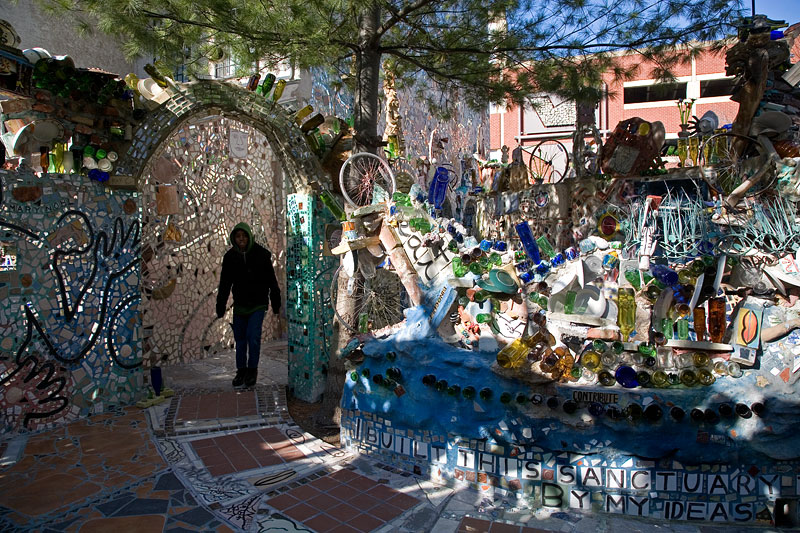
Philadelphia´s Magic Gardens


I didn´t know about the existence of this place, until I shared a picture from Pinterest. Whoever pinned it, left little information about the picture, and the reference was ¨Philly¨ what I figured out Philadelphia???
But the artist´s name, Isaiah Zagar, showed up immediately in Google.
I was moved by the story of the place, more than the folk art, and it´s funny but not so intellectual-artistic from my point of view.
Here, an excerpt from the web page and pictures that I´ve selected:


Philadelphia's Magic Gardens (PMG) is a mosaicked visionary art environment, gallery, and community arts center that preserves, interprets, and provides access to Isaiah Zagar's unique mosaic art environment and his public murals. The Magic Gardens site, Zagar's largest artwork, includes a fully tiled indoor space and a massive outdoor mosaic sculpture garden that spans half a block on Philadelphia's famous South Street. Inside, visitors can view folk art statues, bicycle wheels, colorful glass bottles, Zagar's hand-made tiles, and thousands of glittering mirrors. The installation pays tribute to Zagar's artistic influences, along with community and personal experiences.
Open to visitors daily, PMG has become a unique Philadelphia destination, hosting year-round, low-cost public programs within its own distinctive venue and the surrounding community. PMG, a nonprofit organization, inspires creativity and community engagement by educating the public about folk, mosaic, and visionary art. (....)

Zagar has devoted himself to beautifying the South Street neighborhood since the late 1960s, when he moved to the area with his wife Julia. The couple helped spur the revitalization of the area by purchasing and renovating derelict buildings, often adding colorful mosaics on both their private and public walls. (...)

In 2002, the Boston-based owner of the once-vacant lot located at 1022-1026 South Street decided to sell the land in response to rising South Street property values. Unwilling to witness the destruction of Zagar's neighborhood art environment, the community rushed to support the artist. His creation, newly titled Philadelphia's Magic Gardens, became incorporated as a nonprofit organization with the intention of preserving and promoting Zagar's works at the site of the Magic Gardens and throughout the South Street region. 

Philadelphia's Magic Gardens is now a permanent art institution that is open to visitors throughout the year. Trained guides are available to lead tours of the Magic Gardens and Zagar's surrounding public murals. In addition, PMG offers monthly mosaic workshops led by Zagar himself, and regularly hosts concerts, dance performances, and other public events.


Saturday, June 22, 2013

Old street lamp posts in Southern California

Crowd on a city street (near 5th Street and Coast Federal Savings building)     Joseph Fadler  1970

I´ve always said that Southern California, having a young history of a little more than 100 years, invented its own history.
When you have to design for a historical city or zoning, strict design guidelines have to be followed, and everything has to be ¨to match existing;¨  the historical subject of a particular city must be always present.
That´s why you see the stone pillasters in La Verne everywhere, in signs but also in modern gas stations, with no care for the scale, or the Spanish planters with geranios at the public parking in Santa Barbara, or the street lamps we see here, depicting religious crosses, or a bridge!!!
I´ve been through the project called Form and Landscape which I really enjoyed. It is an on line exhibition of the street scape of Los Angeles and surrounding areas, supported by Edison, the electrical company.
I´ve selected these curious lamps from the exhibition and there is much more to see here:

Street lighting post (Riverside Type) 1916

Mission Bell Streetlights    Art Adams     1966

Rialto Street light post    1916

Lighting, streets    G. Haven Bishop    1912

In the most dazzling displays, some lamp post constellations are crowned with elaborate suns or transformed into starbursts and supernovas.

Sunday, April 14, 2013

Christian symbolism in churches. A reflection on Bradbury´s ¨The Fire Balloons¨

Blue Balloon church. A digital manipulation on Josef Svoboda´s set design. By Myriam Mahiques

Since I bought my simple e-reader, the first book I´ve downloaded from my computer is The Illustrated Man, by Ray Bradbury. I am so happy to go back to the great stories of the tattooed man, specially because when I read it for the first time, I was fifteen years old, and of course now I see I´ve lost many subtle subjects of interest.
Among them, let us remember the story The Fire Balloons. It doesn´t shock us like others, because this is just a tale of Christian evangelization in Mars. Probably I found it boring in my youth.
Today, I am reflecting about father Joseph Peregrine´s goal to find the fire balloons, -supposedly sinner Martians- to convert them. The main question is if they are man or beast.
Once he proves to the other reverends that the round luminous globes of light, have a soul ('Somehow, they saved us. That proves they have souls.'), he decides to build a church in the hills to attract them with a brand new image of Christ:


Father Peregrine drew the round circle in the center of the blackboard.
'This is Christ, the son of the Father.'
He pretended not to hear the other Fathers' sharp intake of breath.
'This is Christ in all his Glory,' he continued.
'It looks like a geometry problem,' observed Father Stone.
'A fortunate comparison, for we deal with symbols here. Christ is no less Christ, you must admit, in being represented by a circle or a square. For centuries the cross has symbolized his love and agony. So this circle will be the Martian Christ. This is how we shall bring Him to Mars.'
The Fathers stirred fretfully and looked at each other.
'You, Brother Mathias, will create, in glass, a replica of this circle, a globe, filled with bright fire. It will stand upon the altar.'
'A cheap magic trick,' muttered Father Stone Father Peregrine went on patiently: 'On the contrary. We are giving them God in an understandable image. If Christ had come to us on Earth as an octopus, would we have accepted him readily?' He spread his hands. 'Was it then a cheap magic trick of the Lord's to bring us Christ through Jesus, in man's shape? After we bless the church we build here and sanctify its altar and this symbol, do you think Christ would refuse to inhabit the shape before us? You know in your hearts He would not refuse.'

Spherical fractal by Myriam Mahiques. To illustrate the idea of Bradbury´s blue light balloons.

There is here this discussion about the symbolism inside a church, a beautiful example of semiotics, the metaphor of the shape. Then, father Peregrine reflects about the location of a church:


'Is it because they are so odd to the eye?' wondered Father Peregrine. 'But what is a shape? Only a cup for the blazing soul that God provides us all. If tomorrow I found that sea lions suddenly possessed free will, intellect, knew when not to sin, knew what life was and tempered justice with mercy and life
with love, then I would build an undersea cathedral. And if the sparrows should, miraculously, with God's will, gain everlasting souls tomorrow, I would freight a church with helium and take after them, for all souls, in any shape, if they have free will and are aware of their sins, will burn in hell unless given their rightful communions.¨

If the priests accept the image of Christ as a balloon, isn´t it a blasphemy? It seems not in father Peregrine´s eyes:


'But that glass globe you wish placed on the altar,' protested Father Stone.
'Consider the Chinese,' replied Father Peregrine imperturbably. 'What sort of Christ do Christian Chinese worship? An oriental Christ, naturally. You've all seen oriental Nativity scenes. How is Christ dressed? In Eastern robes. Where does He walk? In Chinese settings of bamboo and misty mountain and crooked tree.
His eyelids taper, his cheekbones rise. Each country, each race adds something to Our Lord. I am reminded of the Virgin of Guadalupe, to whom all Mexico pays its love. Her skin? Have you noticed the paintings of her? A dark skin, like that of her worshipers. Is this blasphemy? Not at all.¨

Finally, the ¨idea¨ of a church is built, but they need to incorporate elements of their own memories:


¨The church was not a church but an area cleared of rocks, a plateau on one of the low mountains, its soil smoothed and brushed, and an altar established whereon Brother Mathias placed the fiery globe he had constructed.
At the end of six days of work the 'church' was ready.
'What shall we do with this?' Father Stone tapped an iron bell they had brought
along. 'What does a bell mean to them?'
'I imagine I brought it for our own comfort,' admitted Father Peregrine. 'We need a few familiarities. This church seems so little like a church.¨

I won´t be a spoiler telling my readers the end. I´m just wondering if a church, as a building is needed, or if symbols spread in nature would be enough to satisfy our souls.
To illustrate the post, I´ve digitally manipulated an old picture of one of the great theatre sets by Josef Svoboda. The image triggered me the idea of the church designed as a direct symbol of Christ, in this case, as a blue light balloon.


Creative Commons License
Christian symbolism in churches. A reflection on Bradbury´s ¨The Fire Balloons¨ by Myriam B. Mahiques is licensed under a Creative Commons Attribution-NonCommercial-NoDerivs 3.0 Unported License.

Wednesday, March 6, 2013

The importance of the Berlin Wall remnants

Sean Gallup/Getty Images
Police officers stood guard Sunday at the East Side Gallery, part of which was being removed to make way for new apartments.

I was at my parents´ home that day in November 1989 when Pink Floyd was performing The Wall, against the Berlin Wall, and everybody was expecting it to be torn down. And I remember my emotion when this happened.
But I´d never fully understood how it looked after the event and what had been left of it, until Phil Smith sent me a copy of a film made by the walking artist Kinga Araya. The film is called ‘Ten Steps’, it lasts 70 minutes, and it documents Kinga’s 2008 walk along the route of the Berlin Wall.
Apart from her walking experience, she explains how the remnants are intertwined with buildings, or left in domestic gardens, or just a piece of the foundations in parks, etc. 
Today, the wall that was one of the horrors of the WW, the inspiration for so many artists,  the tomb of so many, has become a monument of memories. An the Germans defend it.
Please keep on reading this interesting article:


In Berlin, a Protest to Keep What Remains of the Wall by Chris Cottrell. March 4, 2013


Photo by Fabrizio Bensch/Reuters

In November 1989, the Berlin Wall opened, and soon after was being torn to pieces by jubilant crowds from both sides. Almost a quarter of a century later, Berliners again took to the streets over the wall — only this time to protect what is left of it.

Late last week, when construction workers began dismantling a roughly 70-foot section of the wall’s longest remaining expanse — a nearly mile-long monument to peace that is covered in paintings and is known as the East Side Gallery — protesters turned up in droves. The first hastily organized demonstration on Friday drew several hundred, but over the weekend thousands of people massed to protect the huge concrete slabs from being relocated to an adjacent park.
They were particularly incensed that the project was to make way for an access road for new luxury apartments — helpful for a city whose budget could use bolstering from development, not so helpful for ordinary Germans.
“History should never be a luxury,” read one placard, capturing the protesters’ dismay over gentrification.
City officials and the developer, Maik Uwe Hinkel of Living Bauhaus, responded by noting that the space would also serve the construction of a nearby pedestrian bridge over the river, to replace one destroyed in World War II, according to the daily newspaper Berliner Zeitung.
Many residents view the remaining row of tall concrete slabs as an important testimonial to life in Communist East Germany, when the 28-mile barrier encircling West Berlin severely hampered their contact with the other side, and they are intent on keeping the East Side Gallery intact.
“It’s about letting future generations know what life was like for parts of this city, and at the same time reminding them of the joy that was felt upon reunification,” said Robert Muschinski, 50, an activist who helped organize the demonstrations.
A popular tourist attraction, the stretch of wall snakes along Berlin’s Spree River and is emblazoned with art from 1990 that was restored in 2008 — colorful graffiti and famous murals like the “Fraternal Kiss,” which shows the Soviet leader Leonid I. Brezhnev and his East German counterpart, Erich Honecker, locking lips.
The work crews removed only one four-foot-wide slab before the protesters blocked them. On Monday, Mr. Hinkel called off any further removals until a major meeting with the relevant players in the project set for March 18.
“I am dedicated to the preservation of this piece of the wall,” the German news agency dpa quoted Berlin’s mayor, Klaus Wowereit, as saying.

Walking the wall with Kinga Araya.

If you want to read about Kinga Araya´s experience walking the Berlin wall and buy the film, please click on this link:
http://www.mythogeography.com/kinga-arayarsquos-ten-steps-walking-in-circles.html

East German border guards look through a gap in the Berlin Wall two days after it was breached, 11 November 1989. Photograph: GERARD MALIE/AFP/Getty Images

Read the article by John Henley 

The Berlin Wall: where are the remains?


Friday, January 18, 2013

The skyline of the World Heritage Town Olomouc is in danger!

I have been reading and reflecting on the article by Edwin Heathcote, ¨The bad and the beautiful,¨ about beauty and cities, and I agree that our memories make us feel as beautiful different environments, the sense of belonging that maybe is out of any tourism classification.
But, some cities are beautiful per se, without discussion, and the scale of its urban spaces and the skyline plays a major role in it. Heathcote says:

¨This, however, is all about grandeur, spectacle, the beauty of scale. These are the beautiful cities of cliché and fairy tale. You could equally argue that too much beauty hinders a city. Think of Venice, the sinking tourist city mired in its own past, a city that has become a theme park of decaying beauty.
London, a city to which the epithet “beautiful” can be applied only sparingly, has been threatened with losing its Unesco World Heritage status with dull, yet increasingly strident, towers impinging on historic views of Westminster and the Tower of London. In other cities, such as New York, Chicago, or Hong Kong, skyscrapers are the essence of the city. In London, it is more difficult, particularly as so many towers are so poorly designed, but this municipal carelessness does allow the city to adapt, to keep itself relevant. That is part of the reason London has been able to maintain its status as a trading centre for six centuries.¨


The example of London, reminds me of a similar European case: 

In the last decade the skyline of the World Heritage Town Olomouc (Czech Republic) has been disrupted by two new high-rise buildings of poor architectural value. Currently the construction of the third “skyscraper” named Šantovka Tower is under proposal.  The Civic society For beautiful Olomouc (Czech Republic) rightly considers that the height of this new tower (75 m) and its placement near the protected heritage area, will jeopardize the valuable urban landscape and contribute to the devastation of its unique skyline. 
A private developer SMC Development has hired the architectural firm Benoy (London) for the project. He defends its choice with words about bringing first-class contemporary  world architecture into Olomouc, comparing it with  other Benoy projects in London or Singapore. Local authorities support the building and they are willing to change or bypass legal regulations which do not allow buildings of such height close to a protected area.  


Here are the three buildings, now, let´s take a look at Olomouc´s skyline, after and before:


No need for further explanations, but in an overall view of the city, you´ll understand the problem:

The rectangle on the horizon, would be the new tower. Santovka Tower, by Benoy London, 2013-2015?


For those who´d never been there, I´m sharing an excerpt from wikipedia.org about Olomouc:

Olomouc (/ˈɔːləmoʊts/;[citation needed] Czech: [ˈolomou̯ts]; German: Olmütz; Latin: Olomucium or Iuliomontium; Polish: Ołomuniec) is a city in Moravia, in the east of the Czech Republic. Located on the Morava River, the city is the ecclesiastical metropolis and historical capital city of Moravia. Today it is an administrative centre of the Olomouc Region and sixth largest city in the Czech Republic. The city has about 102,000 residents, but its larger urban zone has a population of about 480,000 people. 
Olomouc is said to occupy the site of a Roman fort founded in the imperial period, the original name of which, Iuliomontium (Mount Julius), would have been gradually corrupted to the present form. Although this account is not documented except as oral history, archaeological excavations close to the city have revealed the remains of a Roman military camp dating from the time of the Marcoman Wars.

 City monuments 

Olomouc contains several large squares, the chief of which is adorned with the Holy Trinity Column, designated as a UNESCO World Heritage Site. The column is 115 ft (35 m) high and was built between 1716 and 1754. The city has numerous historic religious buildings. The most prominent church is Saint Wenceslas Cathedral founded before 1107 in the compound of the Olomouc Castle. At the end of the 19th century, the Cathedral was rebuilt in the neo-Gothic style. It kept many features of the original church, which had renovations and additions reflecting styles of different ages: Romanesque crypt, Gothic cloister, Baroque chapels. The highest of the three spires is 328 ft (100 m), which makes it the second-highest spire in the country (after Cathedral of St. Bartholomew in Plzeň). The church is next to the Bishop Zdík's Palace (also called the Přemyslid Palace), a Romanesque building built after 1141 by the bishop Henry Zdík. Its remains one of the most precious monuments of Olomouc: such an early bishop's palace is unique in Central Europe. The Přemyslid Palace used as the residence of Olomouc dukes from the governing Přemyslid dynasty used to stand nearby. Saint Maurice Church, a fine Gothic building of the 15th century, has the 6th-largest church organ in Central Europe. 
Saint Michael's Church is notable. 
The Neo-baroque chapel of Saint John Sarkander stands on the site of a former town prison. At the beginning of the Thirty Years' War, the Catholic priest John Sarkander was imprisoned here. Accused of collaboration with the enemy, he was tortured, but did not reveal anything because of the Seal of Confession, and died. The torture rack and Sarkander’s gravestone are preserved here. He was canonized by Pope John Paul II during his visit in Olomouc in 1995. John Paul II also visited Svatý Kopeček (Olomouc) (cs) ("The Holy Hillock"), which has the magnificent Baroque church of the Visitation of the Virgin Mary. It overlooks the city. The Pope promoted the church to Minor Basilica. 
Several monasteries are located in Olomouc, including Hradisko Monastery, Convent of Dominican Sisters in Olomouc and others. Carriage in the Olomouc Museum of Art Other notable destinations are the Olomouc Orthodox Church, consecrated to Saint Gorazd (cs), and the Mausoleum of Yugoslav Soldiers. This monument commemorates 1,188 Yugoslav soldiers who died during WWI in local hospitals after being wounded on battlefields. The principal secular building is the town hall, completed in the 15th century. It is flanked on one side by a gothic chapel, now adapted and operated as a museum. It possesses a tower 250 ft (76 m) high, adorned with an astronomical clock in an uncommon Socialist Realist style. (The original 15th c. clock was destroyed at the end of World War II. It was reconstructed in 1947–1955 by Karel Svolinský (cs), who used the government-approved style of the time, featuring proletarians rather than saints. Olomouc is proud of its six Baroque fountains. The fountains survived in such number thanks to the city council's caution. While most European cities were removing old fountains after building water supply piping, Olomouc decided to keep them as water reservoirs in case of fire. The fountains feature ancient Roman motifs; five portray the Roman gods Jupiter (image), Mercury (image), Triton (image), Neptune and Hercules (image). One features the emperor Julius Caesar, the legendary founder of the city (image). In the 21st century, an Arion fountain was added to the main square, inspired by the older project. In the largest square in Olomouc (Horní náměstí - Upper Square), in front of the astronomical clock, is a scale model of the entire old town in bronze.


Maybe more voices help us to protect the World Heritage Town Olomouc. Many European cities have used their cultural heritage as a strategy for (cultural) tourism, but most important is to promote the identity and civic proudness  of the inhabitants.

Here, Dr. Nikos Salingaros´ contribution:


"Olomouc is facing architectural disaster, though promoted with the best of intentions. The city is about to build a third glass-walled skyscraper, even though two earlier ones clearly degraded its architectural heritage and lowered both the city's sustainability and its income-generating potential through tourism. Unfortunately, certain power brokers still insist on gigantism and the fetish of glass-and-steel buildings as an elusive mythology of progress, little realizing that it's only the extremely expensive equivalent of junk food. They hire well-known multinational architectural firms who have their intellectual roots in industrial modernism, and who are experts at building the same alien-iconic building everywhere around the world. Why should a tourist pay money to come to Olomouc when they can see the same glass skyscraper in London or Singapore? The truth is that people are tired of the same futuristic images, and want to experience genuinely human-scale traditional architecture when they travel. But you will never hear this story from the stupid media who blindly repeat the marketing statements of the firms involved. As far as the tremendous wastage and non-recuperable embedded costs of glass skyscrapers, maybe a giant oil-producer like the Czech Republic doesn't mind wasting energy on status symbols of an imagined but false modernity. Just pump more petroleum out of the ground around Pilsen. And who needs those tourists anyway? It's more important for Olomouc to look like Dubai so as to keep up with the architectural insanity of the rest of the world."

To complete Nikos´ statement, here is an interesting data from Global Urban Development Magazine:

¨According to the Travel Industry Association of America, visitors to historic and cultural-attraction sites spend more and stay longer than the other types of US travelers; they spend US $631 and 4.7 nights away from home per trip compared to the average US traveler’s spending of US $457 and 3.4 nights. Several cities have begun to invest in place-identity and heritage tourism. Philadelphia, for example, is investing US $12 million in private and public funds to make heritage tourism a lynchpin in its economic development strategy.  Many cities in Europe have also started to include heritage resources on their urban regeneration agendas.¨


Tuesday, January 15, 2013

About churches´ adaptive reuse


The first time I saw a project of dwellings in a church already deconsecrated, it caught my attention, but I thought, maybe it´s an isolated case. Up till now, I didn´t have a clue of how many churches (of different religions) were kept empty, without use for lack of funds or  because the specific sect or religion had changed the procedures for meetings, or simply because there are too many. So, it is better to sell them to be converted into a different use facility but of course, under severe restrictions.
I understand the typical ones, like ¨no alterations on the facade and style should be made,¨ or to keep the original style, but there´s another very important restriction: Relatives must have rights of access to visit the remains of the deceased. That´s a difficult task...

Even if it is deconsecrated, I would feel that the building has a kind of soul, I don´t feel that the masses and ceremonies can be removed from the building´s (the people´s ) memory just retrofitting the structure, and/ or adding partition walls, or changing interior colors.


An interesting article about this issue has been written by Philippe Ridet at Guardian.co.UK

¨Dozens of computer displays have taken the place of the altar. The church of Santa Teresa in Milan was originally built in 1674, but closed for worship in the early 19th century. The city council purchased the building in 1974 and in 2003 it opened as a media library.
No one can tell how many there are. Neither the Catholic church nor the arts departments at various levels of government have seen fit to count them. But there are probably several thousand places of worship all over Italy which have been deconsecrated and sold. The permutations seem endless: here a bar or a country house, an artist's studio or a garage, there the head office of a bank, a library or function rooms. But sometimes a whiff of incense seems to linger, as if long after the last mass the spirit of the place still clings to the walls.
This may be yet another sign of the hard times on which the church has fallen and Italy's increasingly secular society. But that is not what prompted the Milanese photographer Andrea Di Martino to set up his camera at the entrance to a series of ex-churches. Much as for a passport photograph, he adopted exactly the same angle for each picture: the effect is striking yet poetic, "an encounter between an umbrella and a sewing machine".
Andrea Di Martino is preparing a book with his series ¨The mass is ended.¨ In the following link, you can see the gallery:
Then, I have been reading another article by a real state company in UK, that explains:
¨A recent survey conducted on the website propertyfinder.com found that church conversions were the most popular choice among users for a converted living space, with 60% preferring to live in a converted building rather than purpose built accommodation. The survey brought to light some worrying issues also, with church conversions listed among the worst buildings in terms of value and layout. Bear in mind then, that a church conversion is not carte blanche to an exotic, original living style, but that each one must be assessed on its individual merits just like any other property.
Increasingly, cash strapped ecclesiastical bodies are selling off more and more churches. The Royal Institution of Chartered Surveyors (RICS) says that in the last 5 years around 500 London churches have been turned into homes. There is no need to jump to the conclusion that the entire country has completely lost its faith. The Victorians have a lot to answer for, apparently they simply built too many - even in their time the churches were half-full but, with money pouring into post-industrial Britain, the building went on unabated.

(...)  if you wish to undertake your own church conversion there are a variety of ways to go about this:

  • Anglican Churches - Closed churches are described by the Church of England as those no longer required for public worship and thus formally closed under church legislation (the Pastoral Measure of 1983). The aim of the Pastoral Measure is to find alternative uses for those churches in order to avoid their demolition and preserve our national heritage - conversion into housing is just one such alternative use. The Church of England publish a list of closed churches which you can see here.
  • Methodist Chapels - In the last 75 years, somewhere in the region of 8,000 Methodist chapels have been closed. There are presently around 100 or so scattered across the UK but with a greater concentration in Cornwall, where the sect was most popular. Many of these were constructed in the 19th century and being smaller than Church of England churches are more suitable to conversion as a single home. 
  • Buildings at Risk - If you have an excess of time and money and want to take on a really spectacular project then you might want to check out the Save Buildings at Risk register at savebritainsheritage.org

That´s good that this site highly recommends the buyer to hire a specialist architect to deal with the City planners and to design with respect and experience in  architectural conservation.


In this video, the reporter says that the Americans are the main market for deconsecrated churches converted into houses. It seems that they consider them as the best expression of Italian art.

REFERENCE for pictures above: Andrea Di Martino


Jakob Culture Church today hosts concerts, poetry and opera after being de-consecrated in 1985. From 

An architect that is required to work in ¨adaptive reuse¨ of a church, maybe confronted with a dilemma. Let´s learn more:

¨In most instances, adapting a house of worship to a secular purpose, a measure that in some denominations requires a deconsecration ritual, is the only way to save the building from demolition.
''I personally think it is too bad that so many churches no longer fulfill their original functions, but it is wonderful that we are creative enough to find new functions that will enable them to stay alive and healthy,'' said William J. Higgins, a partner in Higgins & Quasebarth, a preservation consulting firm that did a historical analysis for the St. Peter's project. ''I would rather see the character of the space used as an asset than to obliterate it. If a church becomes an interesting place to socialize, dine, exercise, why not?''
Adaptive reuse, as the process is known, can be daunting. ''These buildings do not lend themselves to easy conversions,'' said Ken Lustbader, who was the director of the New York Landmarks Conservancy's Sacred Sites program until last month. ''It is an expensive proposition to divide up sanctuary space, deal with the placement of floors, windows, electricity, plumbing, wiring.''
In addition, Mr. Lustbader went on: ''It is a more challenging conversion to go from soaring sanctuary to studio apartment. Convents, schools and parish houses lend themselves much more to compatible adaptive reuse, but they do not have the spectacular architectural details.''
Stephen B. Jacobs, an architect, balked when he was asked to design apartments for the alteration of the All Angels Church, a English Gothic-style Episcopal church on the West Side, about 18 years ago . ''I said to the rector, 'Would you sell Westminster or Coventry?' and I told the client, 'I can't rip out the inside of such a wonderful building,' '' he recalled. ''It was sold to a developer who tore it down.''
''A year later,'' he continued, ''another client came to me about another church, and this time I said, 'I'm going to do it.' '' The result was the conversion of the Greek Revival Village Presbyterian Church on West 13th Street into a 15-apartment co-op called the Village Mews Housing Corporation but more commonly known as ''the church.''

LinkWithin

Related Posts with Thumbnails