Showing posts with label Reflections. Show all posts

Sunday, November 10, 2024

Thoughts on "The Wall of Gazes" exhibited at the MOOLA


I had the real pleasure of visiting the current exhibition Arteonica at the Museum of Latin American Art in Long Beach, CA. There were the works of several artists, from Chile, Argentina, Mexico, Switzerland, Brazil. 

The work that impacted me the most was "Wall of Gazes" by Argentinians Mariano Sardón and (neuroscientist) Mariano Sigman. The videos, depicted as transforming portraits were mesmerizing. 


All portraits are superimposed images in videos, the algorithms keep on changing until the face is formed or partially formed. 

From Ars Electronica:

"The Wall of Gazes consists of one screen in which visitors can see how portrait images are revealed by the eye movements of many persons simultaneously. Gazes were captured by an eye tracker device. Around 100 participants were seated in front of a portrait image and the device recorded their gazes for 15 seconds. The screen is connected to a computer and a special software displays the eye tracks stored in a database. Portraits are ever-changing composition, according the gazes captured and displayed by the software." 

The eye tracking data was generated at the Muntref Centro de Arte y Ciencia. Universidad Nacional de Tres de Febrero. Buenos Aires.


It immediately came to my mind the relationship between architectural perception and neuroscience. I researched a little more about this project, and I was pleased to see that it was applied to migrants' memories, to movement, from one country to another as well.

From Mariano Sigman's page:

"Hiwa K tells that border officer ask immigrants questions about the map of his hometown. Most immigrants, like anyone who is asked random questions about the geography of their city, fail the test. This story is the inspiration of our project. We live in small, sparse fragments of our city. The road to school, the bus to our grandmother’s house, the square where time passed relentlessly. Each person has her own city. In this work we investigate this distant memory of an individual’s memory of the city in which they lived. We looked a map while we heard stories by people who moved from Mexico to the United States, from Syria to Austria, from Bolivia to Argentina. Then we reconstruct this, cutting the trajectory of the eyes on a paper map. Because of its own lightness, this map bends when it leans on wood and forms bridges that connect places that are distant in the city, but close in memory."

I think that it would be a step forward to "measure" the perceptions on the architecture that is affected by the dwellers' memories and traditions. In other words, to leave the 2 dimension of the map and see what happens when people is confronted with cultural information on the built environment. And which is the perception of people while observing this, depending on their nationalities and or their studies degree, their intellectuality. For example, I was walking in my neighborhood and saw the -following- homage for the Day of the Dead. The neighbors, I assume, must be Mexican or descendants, but living in the USA, and are expressing themselves with their hearts. Regretting the losses of their young relatives. 

These articulations, the fine details, the offerings, have a real impact on architecture, the altar is like becoming part of it. The facade is completely integrated to the force of culture. Definitely, the three dimension would be worth of farther analysis. 

Altar in my neighborhood, Long Beach, CA. From my personal archives, November 2024.

*All pictures by Myriam Mahiques, November 2024. Please do not share without permission.

Sunday, May 31, 2020

Thoughts about "Hoarders"


Many years ago, one of my posts was about people with compulsive behavior keeping lots of staff inside and around their homes. I'm not a psychologist and I saw this from the point of view of a morphologist, just the occupation of the architectural space.
We had a client, back in 2012, owner of an important house, who used to fill up the rooms with vintage objects, up to the ceiling. She had some illegal constructions and upon comparison with the inspector's pictures, we discovered the owner was relocating stuff and even windows and doors. 
I was surprised, being this my first experience with hoarders. I offered her to buy a nice vintage jar, and she reluctantly sold it to me while warning me "be careful, that's the way you begin to pick up". 
She made the effort to have her legalization plans prepared soon, but she decided not to submit them. After a few meetings with the City inspector, the planner and the City attorney, and due to the inaction on her side, she was arrested and put in jail. Until her brother came back from Europe and got everything done: plans got approved, a contractor was hired to fix the house, which was deeply cleaned, and she was sent to hospital. I don't know what happened then, but I promised the brother to keep the original plans of the house.
Now, trashing old plans I had in a closet, I couldn't get rid of this house blue prints (they are genuinely blue), out of respect for my compromise.


Back in 2018, we had another experience, more serious this time, and the contractor taught me the word: "hoarder". He cleaned part of the house to allow us to take the overall dimensions.
All the time I was wondering how they could live in these conditions where all type of objects, clothes, toys, food etc etc was piled up everywhere.
The lady homeowner had psychological problems, but the husband, after many years of living under the circumstances, seemed to be submissive and in full acceptance of the unhealthy environment.
The son, had a separate clean room and bathroom for himself, like a bubble in a sea of trash.
In my experience, the family accepts the situation and everyone tries to create an independent personal space in the house. This is the best thing they could do.


There's currently a series on Netflix called "Hoarders" which captured my full attention. Not that I like the style of "Big Brother" show, I would have preferred a documentary instead of a sort of short performed novels about the disease.
What is stated is that 19M people in the USA suffer from hoarding disorders. And they are showing some extreme examples.
It seems to be a common factor, which is the lack of interest of the son/daughter in a long period of years. They go away from home, being incapable of dealing with their parent/s disorder and when they come back (they are brought back in the "show") they are repentant they have not seen or realized what was going on inside the house in question. Or with the person in question.

It feels weird to me that a son or daughter does not know how the parent is living this way for so long years, but not all families are the same.
Grievances and tears are abundant and worst of all -in my opinion- is the participation of a licensed psychologist who admonishes the hoarder, in the effort of making him/her realize of his/her bad doings, and what is more, she gives a public diagnostic of the psychological health of the hoarder. 
Which doctor would publicly state the patient's diagnostic openly to the world???? "It's a mental illness!" That is stunning, at least in my mind. And of course I am not criticizing her experience and wish to help, it's just I would have preferred more privacy for the addicted.
Of course, she appears to be a counselor and they are not her patients. And I'm assuming the family is being paid to show all the procedures for the extreme cleaning up in a very short period of time, let's say three days, before Code Enforcement shows up. And this is never enough.

An interesting "legality," is that the cleaners must not take the junk away unless the owner gives them permission. Which is very difficult because what is junk for some, is precious to others. If the hoarder does not allow the removal of objects/ trash, then it could be considered a robbery.

A case that has made me sad, so far, is Patricia's, a lady from Indiana, whose house is deeply full of trash accumulated along 30 years, infected by rats, dogs and human feces, the house is collapsing due to the extra vertical loads and all its component materials are biohazardous given the feces and rotten organics have been absorbed by walls, flooring, foundation. The house is unsafe and worth demolition, but at the end we learn Patricia comes back and her son in law (or so relative) is making some improvements in the house to leave it "somehow" habitable. Because that's the main point, is the hoarder able to live back in the house? Is he /she able to get his/her pets back?
Can he or she be treated or is it a sort of dementia? And it is clear that the whole close family needs therapy.

Coming back to Code Enforcement, they shouldn't let the hoarding reach such a critical point because setting aside the decrease of the property(ies) value, it's absolutely unsafe and contaminating. It seems to me they do not notify the family, but just the homeowner, who cannot understand what is wrong.
In the cases I personally know, not a single social worker was sent to the property. It was all related to the building, to the construction. I see it as a weak point.

NOTES: 
All pictures are screen shots from the "Hoarders" show on Netflix.
On episode 5, another doctor is presented: psychiatrist Melva Green, who has shown a lot of support and compassion. And she helps the hoarders (two of them) to get to the root of their problem which -apparently- is a consequence of their poverty in childhood. 

Tuesday, January 17, 2017

The intriguing poetics of the inside-outside in an open space


I've been at the Shipley Nature Center, which has been opened in 1974 with the aim of educating children on how was California (I should say Southern) 100 years ago.
There are several trails, with different objects, including boomerangs and stones that help the teachers to explain history and indigenous life.
Next to one of the trails I've found two wooden tables with objects aligned on it, which I presume are old musical instruments. The shadows were hard and I was delighted to see the game of light and shadow inside the apse surrounded by trees and wilderness.
And I had this feeling of asking myself if I was inside of a special "room" or outside in the open air, it was confusing, specially when I moved around and could capture the darkness while the tables were in full sun.


So, after downloading my pictures, I grabbed one of my favorite books, Gaston Bachelard's The Poetics of Space and open it randomly, and found these words that helped me reflect on my experience:

"To benefit by all the lessons of modern psychology and all that has been learned about man's being through psycho-analysis, metaphysics should therefore be resolutely discursive. It should beware of the privileges of evidence that are the property of geometrical intuition. Sight says too many things a one time. Being does not see itself. Perhaps, it listens to itself. It does not stand out, it is not bordered by nothingness: one is never sure of finding it, or of finding it solid, when one approaches a center of being. (.....) Sometimes it is in being outside itself that being tests consistencies. Sometimes too, it is closed in, as it were on the outside. (...)
If we multiplied images, taking them in the domain of lights and sounds, of heat and cold, we should prepare a lower ontology, but doubtless one that is more certain than the ontology that reposes upon geometrical images". 

REF. Gaston Bachelard, The Poetics of Space. P. 214-215. USA 1994.


Though taken out of context, I think Bacherlard's words apply to my subject.
Please do not download my pictures without permission.

Saturday, January 16, 2016

Colorful welding and the aesthetics of ruins


¨In August 2013, the Newport Beach City Council authorized the City Arts Commission and City staff to implement a temporary sculpture exhibit in Civic Center Park. The City Council approved the installation of ten sculptures in Phase I of the project and additional ten sculptures in Phase 2. The sculptures installed in year one are on display for two years and will be removed and returned to the artists in 2016. Those installed in year two, or Phase 2, will be removed in 2017.¨

Here I´m showing some details from the sculpture ¨Pretty Boy¨ by David Buckingham.
And this is not that I´m delighted with the sculpture but with its details. I took a lot of pictures of the welding and colorful metal, while thinking how this sculpture will end up in more than one year. What the artist will do with the remnants.


Because if you look in detail, the sculpture has corrosion everywhere already, and maybe this is part of the artist´s intention, that the demon (it´s a demon) would honorably die when he has to be removed from the park.
It also reminded me Albert Speer´s ideal of ruins:

¨ Albert Speer, el arquitecto de Hitler, avanzó sobre el tema en la década del ´30, proponiendo la idea de valor de las ruinas, en su publicación ¨Die Ruinenwerttheorie¨ (La Teoría del Valor de las Ruinas), donde el edificio debía ser diseñado de tal manera que en caso de su eventual colapso, dejaría en pie ruinas estéticamente agradables que pudieran perdurar sin mantenimiento. Speer, no sólo construyó el modelo del Zeppelin en Nuremberg, sino que también mostró cómo aparecería en ruinas luego de cientos de años. Su expectactiva residía en que los restos torcidos de hierro despertaran el mismo heroico entusiasmo que los grandes edificios del pasado que habían conmovido a Hitler¨. 

From my article About the Aesthetics of Ruins, in Spanish, Albert Speer, who was Hitler´s archictect, advanced on the subject in the 30´s proposing the idea of a value for ruins, in his publication ¨Die Ruinenwerttheorie¨, where he stated that the building had to be designed in such a manner that its eventual collapse would leave aesthetically pleasing ruins that could endure without maintenance. He, not only built the model of the Zeppelin in Nuremberg, but also showed how it would look like in ruins, after hundreds of years. His expectation was on the twisted steel that would encourage the same heroic enthusiasm than the great buildings of the past that had moved Hitler.


After all, my pictures are showing ¨Pretty Boy¨ parts as abstract art. 
All pictures by Myriam B. Mahiques, please do not reproduce without my permission.


These are the legs of  ¨Pretty Boy¨ and the grass behind


Sunday, February 15, 2015

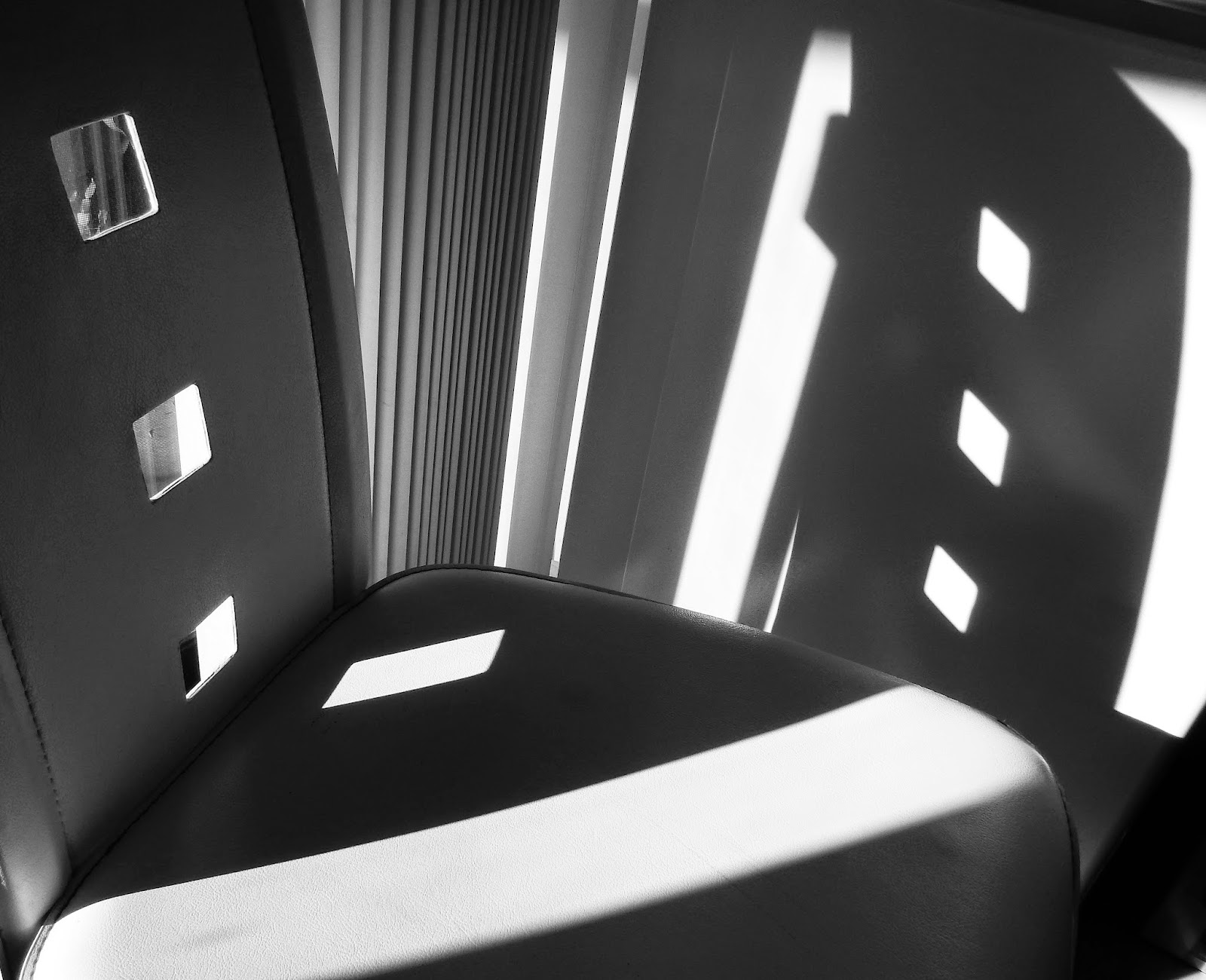
The shadow of a chair. La sombra de una silla


It is well understood that architecture is not interior decor. Though, there are lots of architects who dedicate to the design of furniture, which at last are part of the architecture.
I´m more positioned on Loos´ side, good architecture, in my humble opinion, doesn´t need any decoration. But how dull a kitchen would look without the table, and the clothes, and the chairs....
I am trying to show here how a simple element, like a white leather chair can produce an interesting effect in a boring corner of the kitchen, a concept that makes me think twice about my Loos´ position, at least today, while having breakfast and enjoying the sunlight through the glass doors at 8 AM.

Somebody, and most probably my husband, has left the chair aside, and the hard shadow was drawn on it and on the free standing freezer. Besides, there´s the white shutters behind. All of a sudden, there´s an interesting effect.
Though I was expecting I could take a couple of bright white abstract pictures, my camera wouldn´t allow me to, so I switched to expressionist shots to illustrate my point.


Saturday, January 4, 2014

El lenguaje complejo del arquitecto

Architect´s bingo card. Por Bob Borson

Estaba leyendo un post de Bob Borson sobre las palabras que usan los arquitectos, en su sitio Life of an Architect , y no pude más que reír ante la tarjeta ¨Bingo¨ de arquitectos. Vamos a traducir:
Yuxtaposición, grilla escocesa, jerarquía (una palabra que tanto uso para trabajar con fractales), simetría, claridad, tectonicidad, textura, biomímica, curvilinear, aventanamiento, partido, articulación, masividad, diagrama, pilotes, cáscara, procesión, truncado, forma, emerger, folly: -no encuentro una traducción adecuada en nuestro idioma, es una obra de arquitectura sin sentido-, uniformidad, balance.

El post me hizo reflexionar sobre anécdotas de mi vida, y no siempre profesional. El lenguaje se va incorporando y enriqueciendo con neologismos, casi sin darnos cuenta, y no importa con quién hablemos, nos fluyen las palabras con las que intentamos describir un edificio o una idea. El planteo de Bob es cierto: los clientes no entienden el léxico y cuando pensamos que nos lucimos, pues no, el cliente se retira, enmudece o corta. O hace preguntas para disimular su desconocimiento.
Esta semana, por ejemplo, me llamó un constructor para realizar un plano de hardscape o construcción del paisaje. Para poder pasar mis honorarios, le pregunté si además necesitaba una tabla con los nombres científicos de las especies. Ante el silencio, me dí cuenta de mi error, y traté de llevar la conversación por caminos más conocidos.

Otro problema del cual siento ¨mea culpa¨ es la respuesta via email, las explicaciones técnicas. 
Siendo investigadora formada, y llevando tantos años en obra, solucionando problemas, mis respuestas son muy precisas, estrictas, más bien como reportes. Una vez un cliente me dijo que mis emails sonaban ¨agresivos¨, sin serlo. Desconcertada, le redirigí mi email a mi esposo, -arquitecto-, y le pregunté qué pensaba, dónde estaría la cuestión. Y me respondió, que en la modalidad estadounidense, primero debiera ¨deshacerme¨ en saludos, amabilidades, luego escribir con más naturalidad (domesticidad) y no parecer un abogado; el final del texto debe ser igualmente florido y con extensos agradecimientos, saludos y buenos deseos. He de practicar este año para mejorar mi comunicación virtual.

Una ¨desestructura¨ (mi neologismo) de palabras que hice con una muestra de Piet Mondrian en NY

Otra de mis ¨desestructuras¨.

Volviendo al teléfono, algunos -un 50% diría- señores mexicanos me han cortado, sencillamente porque no reconocen que una mujer de explicaciones técnicas; en general preguntan por mi esposo, siento la frustración si ¨él¨ no se encuentra y soy afortunada si logro continuar la conversación; el mes pasado, no obstante decir que era su socia, un señor pregunta ¨pero Ud sirve el café o atiende el teléfono?.¨

Daré otros ejemplos de palabras, algunas también mencionadas en las divertidas tarjetas de Bob, y si Ud lector es arquitecto, será bienvenido a agregar otras:

Formal, conglomerado y aglomerado (en fractalidad hay diferencias, la traducción general al inglés sería clusters), tensores, cerchas, secuencia, orden, ambientalismo, medio ambiente, miembros estructurales, transición, mallas, grillas, gestos, geotérmico, miesiano, corbusierano, Corbu, racionalismo, sustentable, retórica, complejidad, cantilever, fundación, bases corridas, integración, configuración, fondo y figura, contextualismo, espacialidad, mancha de aceite, conectores, grafos, sistema, tejido urbano, historicismo,  edificios inteligentes, etc.....


Conclusión: nada mejor que un dibujo claro y sencillo para expresarnos con quienes no son nuestros colegas. Al respecto, estoy haciendo una colección de ilustraciones arquitectónicas en Pinterest, de las cuales extraigo ¨A Hill with a Hole¨, posteada previamente por Endless forms most beautiful en Flickr. El trabajo pertenece a los artistas rusos contemporáneos Brodsky y Utkin.


Saturday, November 9, 2013

Homeless in the Central Park of Huntington Beach (!)

This picture was downloaded to my National Geographic account, here

The Library and Central Park of Huntington Beach, Southern California, is one of my favorite places.
I've been there many times, buying books and taking pictures everywhere, in different seasons.
Sometimes we go for a walk with my husband, like anybody else in Huntington Beach, because this is not a park for tourists, but for the neighbors, and we are proud of its beauty and peace.
Today, I went alone, and decided to venture away from the walkways to take different pictures from the ducks and landscape. I wanted to focus in textures and fallen Eucalyptus. 


The first things that caught my attention were pretty worn out clothes hanging from the trees. That was unusual because there are no seats around, and people were away from this spot.
Then, I walked to the new circle of pine trees and went to the woods in the area surrounding the lagoon. A jade green pond was bright and beautiful with moss and I got closer to take pictures of it. I was surprised to see the blue and the red of someone's belongings, plus a sign and a big picture frame. That was a nice composition for my shot, the first one I have here.
But when I looked up, I saw in astonishment that more colorful things were everywhere, clothes, toilette paper, bottles, plastics, etc. as you can notice in the following pic, though I wouldn't dare to go farther, just in case. Music was being played from a radio, coming from this spot. A hidden place for homeless.


I've felt somehow nervous, evaluating my situation. A lady alone, inside the woods, if something happened, who could hear me? I went back to the library and on my way I managed to take more pictures, there are narrow paths that lead to areas enclosed by nature, and every time I could see covers, toilette papers, bags, remains of human habitat. In another wood, children were playing seek and hide with plastic guns, pure fun, unaware of the homeless protected by the wet and dense trees. And of course, the worn out clothes were still hanging on the Eucalyptus after my long walk.


Here I am sharing my pictures, even graffiti I've found on the trees. I've spoken to the person in charge of the Library security and he said, I know, and this is not one person, there are four over there, another two....etc. Now I was upset. So, did you know it already?
The security guard said as they are not inside the Library area, the problem belongs to the police department, and that when they are called, they make a few tickets, get rid of the homeless and then, they immediately come back to their settlements. And there is still more, people living in their RVs at the parking lots under the trees. Though there were complaints, they would stay the whole day, it doesn't matter if the park is closed at night.
And I insisted, don't you think it's dangerous? (He totally agreed with me). Who could hear if something happens in the density of the trees? I am not against the homeless, but when they are on the streets, you can watch their behavior, they are exposed.
In Huntington Beach Central Park there is no way they could be exposed, not them, not anybody who would venture to come across with them. What happens after the park is closed? Who knows. Maybe they are just poor people, it doesn't mean they are dangerous. But maybe not.


I have to confess it took me by surprise. Huntington Beach is a very safe city, not to be compared with any other in Los Angeles County. I remember once, two kids were about to fight in the corner of my house, there were a few more surrounding them. A neighbor called the police and there were police cars and a helicopter in minutes. Just for a kids fight!
The Security guard suggested me to contact the police as a citizen, do not send them emails or do not call them, speak to them directly, show them the pictures and please do us this favor. If the citizens complain, they will have more power than us public employees.
I've not contacted the police yet, but I'll do, and most probably I will update this post.

If you reader, are living in Huntington Beach, and like to walk in the park with your family, please be aware of this situation and help us to denounce it. Let's keep this city as safe as always and let's help the homeless to live in better places than the lagoon surroundings.
Your comment is very welcome!.

Saturday, June 1, 2013

¿Debe la universidad ser arancelada? Una reflexión sobre dos posturas opuestas

El día 24 de mayo de 2013, el diario La Nación on line ha publicado un artículo sobre el Dr. Umberto Eco (F1) desde Burgos, España, quien hiciera una declaración que ha desatado una fuerte controversia entre los lectores argentinos. Reproduzco aquí dos párrafos del mismo:

¨El excesivo número de alumnos y la sustitución del papel del docente por Internet son los principales problemas de las universidades, sostuvo el escritor Umberto Eco, para quien estas instituciones académicas deben ser "para una elite" como recordó que fue en sus mejores épocas.
"El exceso de alumnos entorpece la actividad académica y aboca a las universidades a la crisis", mientras que "la progresiva influencia de las nuevas tecnologías ha modificado la relación de los alumnos con los profesores, especialmente a raíz de la explosión de Internet, desde donde se puede acceder a mucha información, lo que en parte sustituye al papel del docente", sostuvo en conferencia de prensa.¨
F1. Dr. Umberto Eco
Habiendo yo pasado por todas las instancias, estudiante, docente, madre de hijos estudiantes, en Buenos Aires y en California, he tenido oportunidad de evaluar los pro y los contra de las regulaciones extremas: la universidad gratuita y la excesivamente onerosa.
Voy a basarme en la FADU (Facultad de Arquitectura, Diseño y Urbanismo de Buenos Aires) (F2), mas entiendo que en toda Argentina, los profesores nunca han sido reconocidos en su categoría docente, con un sueldo acorde a su profesión; es bien conocido que un profesor adjunto, puede tener un cargo asignado por la cátedra, pero oficialmente cobra como docente de segunda o trabaja ad honorem, como es mi posición actual de investigadora formada. Aquéllos que tienen más inquietudes académicas, participan u organizan grupos de proyectos, que son arancelados, lo que genera serias competencias interinas.
F2. FADU
La falta de presupuesto asignado a las universidades, sumado a la falta de aranceles, provoca esta ansiedad a la asignación monetaria por el ¨proyecto,¨ de quienes se resignan a ejercer la docencia dentro y fuera de los claustros, porque no se llega a tiempo, en épocas de entregas, a atender a grupos masivos, dentro de los cuales, muchos alumnos están en la universidad flotando a la deriva, sin ansias de progreso, imbuídos en actividades políticas (F3) sólo para ocupar el tiempo ante la ausencia de fuentes laborales. Cabe objetarse, por qué los profesores harían ese sacrificio? Pues, la vocación, el amor a nuestra carrera, siempre está por encima de todo.
Difícil es la discusión acerca de presupuestos nacionales, si los hospitales están en peores condiciones, qué organizaciones debieran ser privilegiadas, con arcas vacías y la corrupción política, no se ve solución.
F3. Centro de estudiantes, FADU
Veamos la otra cara de la moneda. Los jóvenes en EEUU asisten en su gran mayoría a escuelas públicas; desde sus primeros años en la secundaria, se les enseña a disertar y escribir, a investigar más allá de las publicaciones en Internet,  lo que será importante a la hora de postularse para becas.
Los colegios son gratuitos, incluso los libros y gran parte de los materiales; llegado el fin de curso, si el alumno alcanza un promedio alto, puede solicitar ser admitido en alguna universidad de su elección. He aquí el punto crucial: la universidad tiene el derecho de admisión, y un alumno mediocre, no puede acceder, por más dinero que posea la familia, para pagar carreras universitarias que están en el rango de los $100.000 (léase dólares) y más aún.
Sin embargo, hay una solución intermedia: el college (F4), que funciona como las ¨stepping stones;¨ el alumno asiste al college pagando un módico arancel mensual, refuerza las materias que necesita, avanza, y si lo desea, logra un título intermedio con salida laboral.
Algunas de estas materias están reconocidas en las Universidades, lo cual abarata el plan de estudios, que, para quienes no tienen los medios, es a largo plazo.
F.4. Lecture Hall, Cypress College
Los estudiantes comienzan a trabajar a los 16 años, mediante un permiso del colegio, y de allí en más, acumulan sus ahorros en bancos internacionalmente conocidos, que evalúan el progreso de los adolescentes para –en años venideros- ofrecerles préstamos de estudios, tarjetas de crédito, lo que necesiten para estudiar. Para los ciudadanos y residentes permanentes, también hay préstamos del Estado pagaderos mensualmente a partir de los seis meses en que el alumno se ha recibido; si el alumno abandona -incluso temporalmente- los estudios, se le retira el préstamo y ya debe comenzar a pagar.
Una última opción, que a veces es oportuna para estudiantes extranjeros, son las becas privadas, como las de dependencias de la fundación Getty, Coca Cola, entre otras.
La diferencia con nuestras aulas, es que los profesores pueden con su sueldo (y deben) ocuparse full time, sin distracciones de segundos y terceros trabajos para sobrevivir, el alumno madura más rápido al tomar responsabilidades financieras y descubre la importancia de la profesión. En sencillas palabras, no va a la facultad a perder su tiempo y los que llegan a la meta, son los mejores.
Todo ello da como consecuencia que si bien los que se reciben son menos, por el contrario, las oportunidades de trabajo son mayores, mientras otros están dispersos en carreras no tradicionales, las opciones y ventajas son muchas.
Finalmente, nótese que la universidad de elite se sustenta en la ayuda del Estado y fundaciones. Sin su apoyo, sería imposible pensar en aranceles, que considero realmente necesarios para lograr, en última instancia, mejores profesores y alumnos, como profesionales y personas que no necesiten bloquear los pasos de otros en pos de su propio beneficio. (F5)
F5. Calstate Long Beach
Arq. Myriam B. Mahiques, 25 de mayo de 2013

REFERENCIAS FOTOGRÁFICAS
F1. Dr. Umberto Eco. Foto archivo La Nación, publicada en el artículo de referencia.
F2. FADU. Foto publicada en el artículo
F3. La politización de la FADU a través de su Centro de Estudiantes. Foto de
F4. Lecture Hall en Cypress College Fine Arts. Foto de Vera Makianich
F5. Vista aérea de un sector del campus de CalState Long Beach, California. Bajada de la página web.

Creative Commons License
¿Debe la universidad ser arancelada? Una reflexión sobre dos posturas opuestas by Myriam B. Mahiques is licensed under a Creative Commons Attribution-NonCommercial-NoDerivs 3.0 Unported License.

Sunday, April 14, 2013

Christian symbolism in churches. A reflection on Bradbury´s ¨The Fire Balloons¨

Blue Balloon church. A digital manipulation on Josef Svoboda´s set design. By Myriam Mahiques

Since I bought my simple e-reader, the first book I´ve downloaded from my computer is The Illustrated Man, by Ray Bradbury. I am so happy to go back to the great stories of the tattooed man, specially because when I read it for the first time, I was fifteen years old, and of course now I see I´ve lost many subtle subjects of interest.
Among them, let us remember the story The Fire Balloons. It doesn´t shock us like others, because this is just a tale of Christian evangelization in Mars. Probably I found it boring in my youth.
Today, I am reflecting about father Joseph Peregrine´s goal to find the fire balloons, -supposedly sinner Martians- to convert them. The main question is if they are man or beast.
Once he proves to the other reverends that the round luminous globes of light, have a soul ('Somehow, they saved us. That proves they have souls.'), he decides to build a church in the hills to attract them with a brand new image of Christ:


Father Peregrine drew the round circle in the center of the blackboard.
'This is Christ, the son of the Father.'
He pretended not to hear the other Fathers' sharp intake of breath.
'This is Christ in all his Glory,' he continued.
'It looks like a geometry problem,' observed Father Stone.
'A fortunate comparison, for we deal with symbols here. Christ is no less Christ, you must admit, in being represented by a circle or a square. For centuries the cross has symbolized his love and agony. So this circle will be the Martian Christ. This is how we shall bring Him to Mars.'
The Fathers stirred fretfully and looked at each other.
'You, Brother Mathias, will create, in glass, a replica of this circle, a globe, filled with bright fire. It will stand upon the altar.'
'A cheap magic trick,' muttered Father Stone Father Peregrine went on patiently: 'On the contrary. We are giving them God in an understandable image. If Christ had come to us on Earth as an octopus, would we have accepted him readily?' He spread his hands. 'Was it then a cheap magic trick of the Lord's to bring us Christ through Jesus, in man's shape? After we bless the church we build here and sanctify its altar and this symbol, do you think Christ would refuse to inhabit the shape before us? You know in your hearts He would not refuse.'

Spherical fractal by Myriam Mahiques. To illustrate the idea of Bradbury´s blue light balloons.

There is here this discussion about the symbolism inside a church, a beautiful example of semiotics, the metaphor of the shape. Then, father Peregrine reflects about the location of a church:


'Is it because they are so odd to the eye?' wondered Father Peregrine. 'But what is a shape? Only a cup for the blazing soul that God provides us all. If tomorrow I found that sea lions suddenly possessed free will, intellect, knew when not to sin, knew what life was and tempered justice with mercy and life
with love, then I would build an undersea cathedral. And if the sparrows should, miraculously, with God's will, gain everlasting souls tomorrow, I would freight a church with helium and take after them, for all souls, in any shape, if they have free will and are aware of their sins, will burn in hell unless given their rightful communions.¨

If the priests accept the image of Christ as a balloon, isn´t it a blasphemy? It seems not in father Peregrine´s eyes:


'But that glass globe you wish placed on the altar,' protested Father Stone.
'Consider the Chinese,' replied Father Peregrine imperturbably. 'What sort of Christ do Christian Chinese worship? An oriental Christ, naturally. You've all seen oriental Nativity scenes. How is Christ dressed? In Eastern robes. Where does He walk? In Chinese settings of bamboo and misty mountain and crooked tree.
His eyelids taper, his cheekbones rise. Each country, each race adds something to Our Lord. I am reminded of the Virgin of Guadalupe, to whom all Mexico pays its love. Her skin? Have you noticed the paintings of her? A dark skin, like that of her worshipers. Is this blasphemy? Not at all.¨

Finally, the ¨idea¨ of a church is built, but they need to incorporate elements of their own memories:


¨The church was not a church but an area cleared of rocks, a plateau on one of the low mountains, its soil smoothed and brushed, and an altar established whereon Brother Mathias placed the fiery globe he had constructed.
At the end of six days of work the 'church' was ready.
'What shall we do with this?' Father Stone tapped an iron bell they had brought
along. 'What does a bell mean to them?'
'I imagine I brought it for our own comfort,' admitted Father Peregrine. 'We need a few familiarities. This church seems so little like a church.¨

I won´t be a spoiler telling my readers the end. I´m just wondering if a church, as a building is needed, or if symbols spread in nature would be enough to satisfy our souls.
To illustrate the post, I´ve digitally manipulated an old picture of one of the great theatre sets by Josef Svoboda. The image triggered me the idea of the church designed as a direct symbol of Christ, in this case, as a blue light balloon.


Creative Commons License
Christian symbolism in churches. A reflection on Bradbury´s ¨The Fire Balloons¨ by Myriam B. Mahiques is licensed under a Creative Commons Attribution-NonCommercial-NoDerivs 3.0 Unported License.

LinkWithin

Related Posts with Thumbnails