Thursday, October 6, 2016

Strange landscapes. An exercise with morphology, colors and reflections


As the title says, I´m creating landscapes with mountains that I create taking the advantage of reflections with different sources of color on Aluminum foil.
The exercise, apart from having interesting artistic results, has moved me to simulate organic architectural structures -that are so well known today- which I will analyze under fractal concepts and will define which is the best way to measure them. This will be part of another post or publication.
I´ve selected Aluminum to achieve a comparison with metals, specially Titanium.
Please do not reproduce without permission.


Saturday, January 16, 2016

Colorful welding and the aesthetics of ruins


¨In August 2013, the Newport Beach City Council authorized the City Arts Commission and City staff to implement a temporary sculpture exhibit in Civic Center Park. The City Council approved the installation of ten sculptures in Phase I of the project and additional ten sculptures in Phase 2. The sculptures installed in year one are on display for two years and will be removed and returned to the artists in 2016. Those installed in year two, or Phase 2, will be removed in 2017.¨

Here I´m showing some details from the sculpture ¨Pretty Boy¨ by David Buckingham.
And this is not that I´m delighted with the sculpture but with its details. I took a lot of pictures of the welding and colorful metal, while thinking how this sculpture will end up in more than one year. What the artist will do with the remnants.


Because if you look in detail, the sculpture has corrosion everywhere already, and maybe this is part of the artist´s intention, that the demon (it´s a demon) would honorably die when he has to be removed from the park.
It also reminded me Albert Speer´s ideal of ruins:

¨ Albert Speer, el arquitecto de Hitler, avanzó sobre el tema en la década del ´30, proponiendo la idea de valor de las ruinas, en su publicación ¨Die Ruinenwerttheorie¨ (La Teoría del Valor de las Ruinas), donde el edificio debía ser diseñado de tal manera que en caso de su eventual colapso, dejaría en pie ruinas estéticamente agradables que pudieran perdurar sin mantenimiento. Speer, no sólo construyó el modelo del Zeppelin en Nuremberg, sino que también mostró cómo aparecería en ruinas luego de cientos de años. Su expectactiva residía en que los restos torcidos de hierro despertaran el mismo heroico entusiasmo que los grandes edificios del pasado que habían conmovido a Hitler¨. 

From my article About the Aesthetics of Ruins, in Spanish, Albert Speer, who was Hitler´s archictect, advanced on the subject in the 30´s proposing the idea of a value for ruins, in his publication ¨Die Ruinenwerttheorie¨, where he stated that the building had to be designed in such a manner that its eventual collapse would leave aesthetically pleasing ruins that could endure without maintenance. He, not only built the model of the Zeppelin in Nuremberg, but also showed how it would look like in ruins, after hundreds of years. His expectation was on the twisted steel that would encourage the same heroic enthusiasm than the great buildings of the past that had moved Hitler.


After all, my pictures are showing ¨Pretty Boy¨ parts as abstract art. 
All pictures by Myriam B. Mahiques, please do not reproduce without my permission.


These are the legs of  ¨Pretty Boy¨ and the grass behind


Tuesday, November 17, 2015

Shutters perspectives or the art of shutters. Perspectiva de persianas o el arte de las persianas


Plastic shutters unusual perspectives with the sun of 7.30 AM through them. Or how to look at banal architectural objects from an artistic point of view.

Perspectivas inusuales de unas persianas de plástico con el sol de las 7.30 AM a través de ellas. O cómo mirar los objetos banales de la arquitectura desde un punto de vista artístico.

Para ilustrar con palabras acerca de encontrar el arte (la estética) en las pequeñas cosas, citaré a Benedetto Croce:

¨....algunas expresiones harto complicadas y difíciles aciertan a manifestarse con excelencia y se las llama obras de arte. Los límites de las expresiones -intuiciones que se denominan arte, con relación a las que se califican de no arte- son empíricos y es imposible definirlos. Un epigrama pertenece al arte; ¿porqué no una palabra sencilla? Un cuento pertenece al arte; ¿porqué no una simple nota de información periodística? Un paisaje pertenece al arte; ¿por qué no un esbozo topográfico? (.....) así tampoco puede haber una ciencia de las grandes intuiciones y otra de las pequeñas, una de la intuición común y otra de la intuición artística, sino una sola estética, ciencia del conocimiento intuitivo o expresivo, que es el hecho estético o artístico. Esta estética se corresponde perfectamente con la lógica, que abraza, como cosas de la misma naturaleza, la formación del concepto más pequeño y ordinario y la construcción del más complicado sistema científico y filosófico.¨

Benedetto Croce. Estética. pp 98-99. Ediciones Nueva Visión, Buenos Aires, 1969


Sunday, November 1, 2015

Details from ¨Sacred Realms: Temple Murals by Shashi Dhoj Tulachan¨


Sacred Realms: Temple Murals by Shashi Dhoj Tulachan From the Gayle and Edward P. Roski Collection.

I´ve been enjoying this great exhibition today at the Bowers Museum in Santa Ana. It´s impossible to capture the beauty of the whole temple murals but at least I am sharing some details. Please do not reproduce without my permission.


¨ The nine oversized paintings shown in this exhibition are all the work of one extraordinary 69-year-old Buddhist monk named Shashi Dhoj Tulachan, a second generation thangka artist living
in Tuksche, a remote village located in Mustang, Nepal's northernmost district adjacent to Tibet.
Shashi Dhoj Tulachan has devoted much of his life to the restoration of a nearby 16th century gompa (Tibetan monastery) known as the Chhairo Gompa.
He is part of a local initiative, the Kali Gandaki Foundation Trust, which is dedicated to raising money to preserve the Chhairo Gompa.
The practice of thangka painting is centuries old and is an art carried out by highly trained monks for the purpose of teaching about Buddha and the tenets of the Buddhist religion. The overwhelming amount of detailed imagery in each painting includes deities, mythologies, and the use of repeated and abstracted design. For those seeking enlightenment, thangka paintings exist as objects of meditation.
The paintings in this collection are not thangkas in the traditional sense. Thangkas are usually much smaller and are rolled on canvas so that they can be easily transported and hung anywhere for teaching. The thangkas exhibited here are similar in size to mural paintings found in monasteries. These paintings also deviate from the rules for the creation of a thangka where the exact use of color, shape, proportion, characteristics and qualities of the imagery are all strictly regulated.
Shashi Dhoj Tulachan has painted this set of images by combining the traditional motifs of one of the foremost schools recognized by high-level monks in Tibet today, the Tibetan Karma Ghadri School, with images that are purely and cleverly of his imagination. The vibrant colors he used are made from natural mineral pigments.¨


Saturday, September 12, 2015

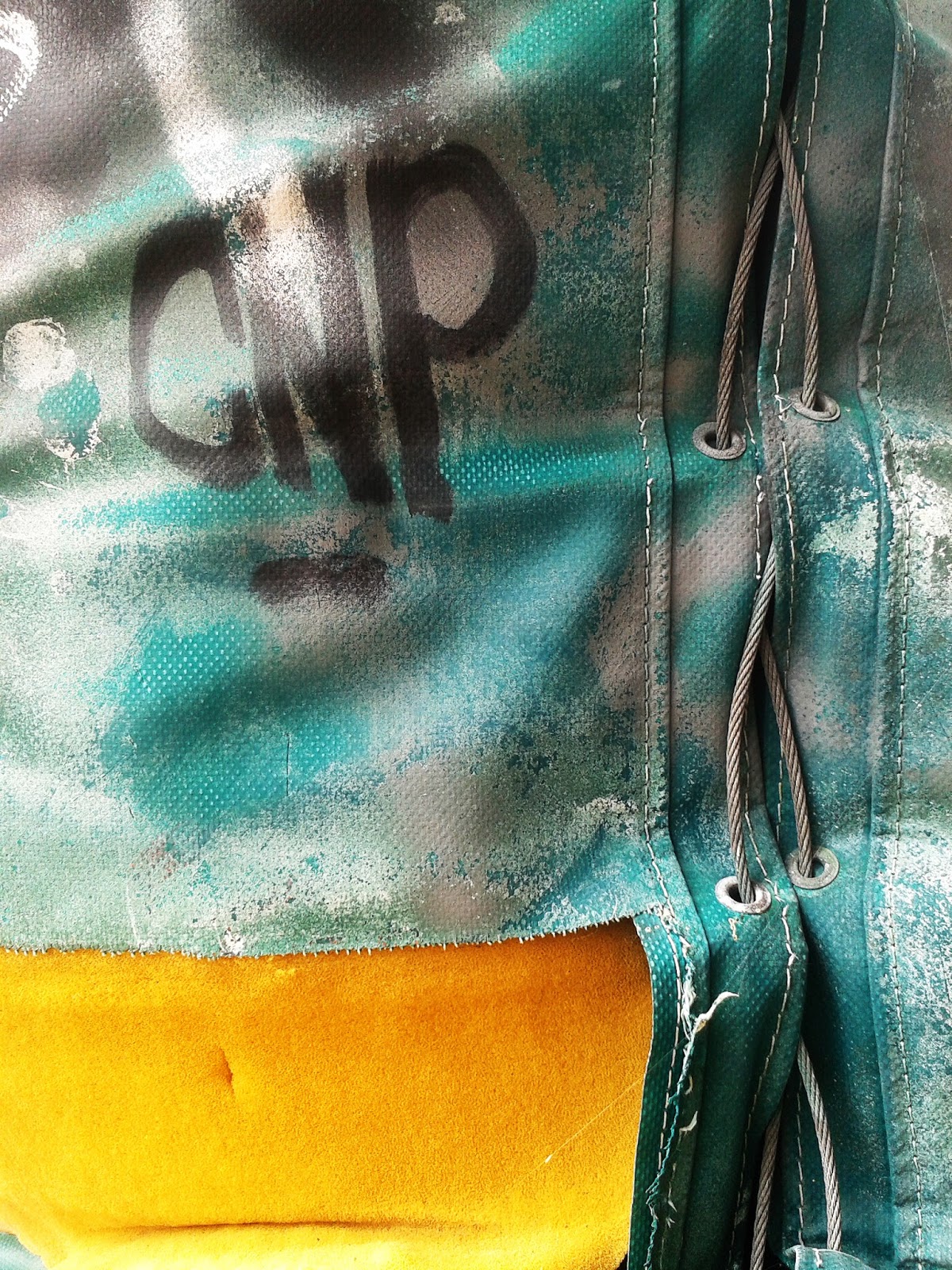
Graffiti abstracts at Murdy park


Murdy Park is ill famed in the city of Huntington Beach. Being it a beautiful park with a Sports Center, sometimes gangs or addicts gather under the trees, maybe because this area of trees is somehow isolated from the sports fields. The police is aware of the problem and it seems everything has been quiet in the last years.
Anyway, there are graffiti on the torn canvas and sponge that serve as protection for the huge lighting columns. And today, while I was walking around, I took some pictures that I consider artistic, setting aside the social problem.
Please do not reproduce without my permission.


LinkWithin

Related Posts with Thumbnails