Thursday, March 9, 2017

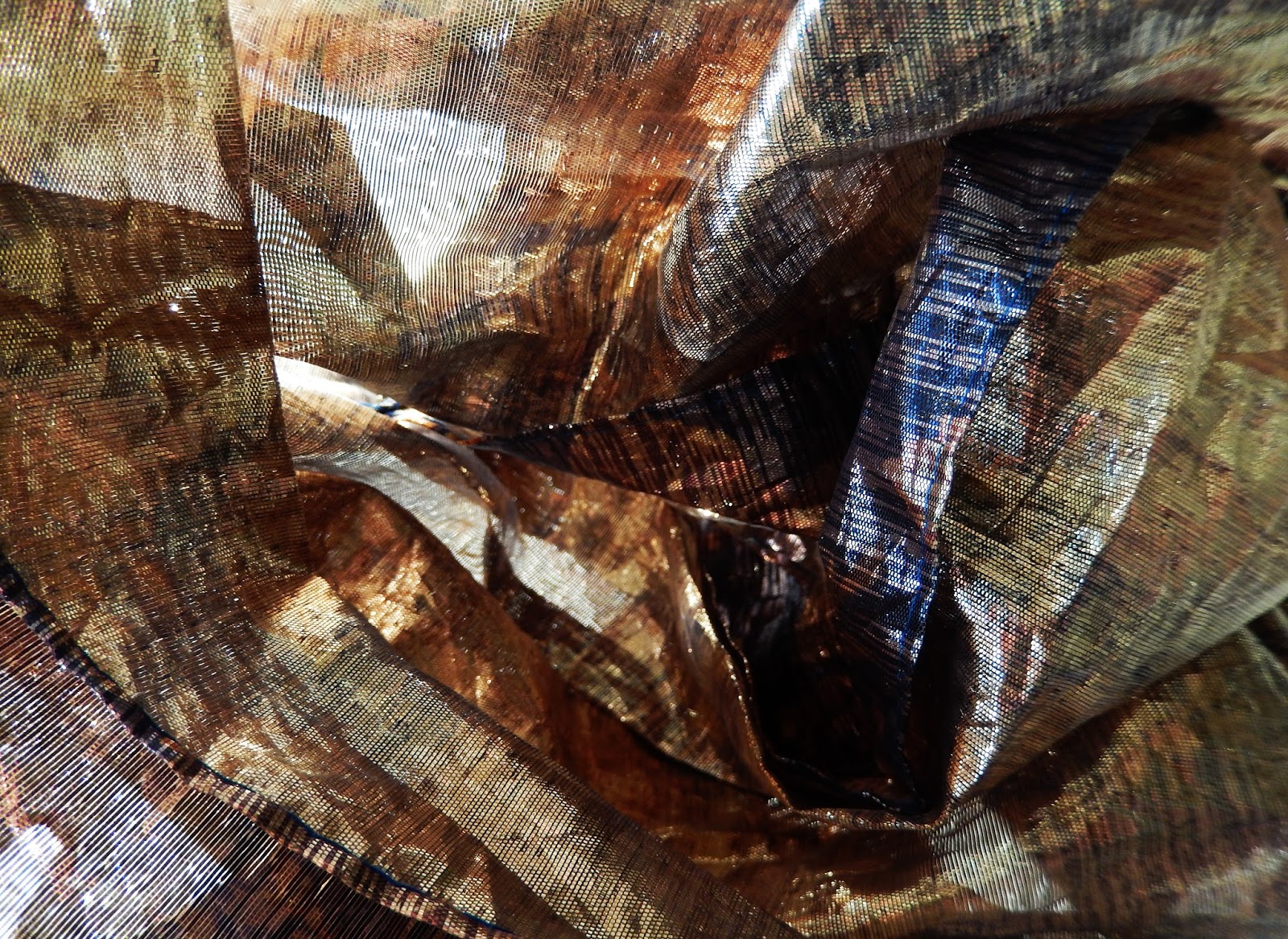
Upgrading spatiality from a 2D plain fabric


I am always thinking of three dimension or upgrading 2D to 3D spatiality.  This is a natural habit for an architect´s profession and I find it amusing when I pass a plain 2D to 3D thanks to the possibility of shrinking materials, like Aluminum foil, painted canvas, and some fabrics as well.
This is a Japanese scarf that I have found by chance inside a beautiful embroidered purse that I bought at the local swap meet long years ago. 
I don´t wear it since the colors are golden and it looks weird in everyday clothes, but I decided to make some art out of it.
The fabric is splendid, it has those golden tints mixed with blues and reds. It´s hard to manipulate and I used a glass container to keep a shape like the insides of a cave.
I take it as an interesting exercise of shapes, colors and lighting. My pictures were taken today.
I hope they are inspiring for architectural designs....


Friday, March 3, 2017

Wire mesh and colors abstracts


Paying attention to details, this standard wire mesh looks very interesting with its shadows against a warning sign. Geometric patterns are mixed together and produce this enhanced view of three dimension. My picture taken on March 2nd 2017 at the local park, in the late afternoon.


Saturday, February 4, 2017

Arts and 3D architecture


 This is the art of Hwang Seon Tae, it's like an acrylic panel with a dull grey architectural composition. A picture has to be taken in order to see the shadows and the 3D image. I took the picture together with ten more people, and once I was done, I saw a handwritten tiny sign around the stand corner "do not take pictures", which I think was a joke.....From Los Angeles Art Show 2017.

Thursday, February 2, 2017

When landscape is incorporated to arts


I came across a young artist, Eric, at the local park. He had extended a wrinkled plastic film between two pine trees to paint a blueish graffiti, which he was going to trash later on. I asked permission to take a few pictures and told him that it was very interesting to see the pine trunks and the grass behind. He looked at me in surprise, he was so focused in his art that he didn´t notice the trees were part of it. He thanked me and said he was happy that I had a different point of view.
I suggested him to see what happened around 5PM in the Winter sunset, those trees have very hard beautiful shadows on the grass and the effect would be different.
Arts X 2= the painting plus the photograph with the landscape incorporated to it.


Tuesday, January 17, 2017

The intriguing poetics of the inside-outside in an open space


I've been at the Shipley Nature Center, which has been opened in 1974 with the aim of educating children on how was California (I should say Southern) 100 years ago.
There are several trails, with different objects, including boomerangs and stones that help the teachers to explain history and indigenous life.
Next to one of the trails I've found two wooden tables with objects aligned on it, which I presume are old musical instruments. The shadows were hard and I was delighted to see the game of light and shadow inside the apse surrounded by trees and wilderness.
And I had this feeling of asking myself if I was inside of a special "room" or outside in the open air, it was confusing, specially when I moved around and could capture the darkness while the tables were in full sun.


So, after downloading my pictures, I grabbed one of my favorite books, Gaston Bachelard's The Poetics of Space and open it randomly, and found these words that helped me reflect on my experience:

"To benefit by all the lessons of modern psychology and all that has been learned about man's being through psycho-analysis, metaphysics should therefore be resolutely discursive. It should beware of the privileges of evidence that are the property of geometrical intuition. Sight says too many things a one time. Being does not see itself. Perhaps, it listens to itself. It does not stand out, it is not bordered by nothingness: one is never sure of finding it, or of finding it solid, when one approaches a center of being. (.....) Sometimes it is in being outside itself that being tests consistencies. Sometimes too, it is closed in, as it were on the outside. (...)
If we multiplied images, taking them in the domain of lights and sounds, of heat and cold, we should prepare a lower ontology, but doubtless one that is more certain than the ontology that reposes upon geometrical images". 

REF. Gaston Bachelard, The Poetics of Space. P. 214-215. USA 1994.


Though taken out of context, I think Bacherlard's words apply to my subject.
Please do not download my pictures without permission.

Sunday, January 15, 2017

Artist's architectural 3D models from L.A. Art Show 2017


 I love the way these tridrimensional metal models have been done, somehow they look 2D, depending on the point of view, or even 3D renders, but they are mass models attached to one single color panel. This is the work of Kim Byungjoo. Exhibited at Los Angeles Art Show 2017, my pictures taken yesterday.


Thursday, October 6, 2016

Strange landscapes. An exercise with morphology, colors and reflections


As the title says, I´m creating landscapes with mountains that I create taking the advantage of reflections with different sources of color on Aluminum foil.
The exercise, apart from having interesting artistic results, has moved me to simulate organic architectural structures -that are so well known today- which I will analyze under fractal concepts and will define which is the best way to measure them. This will be part of another post or publication.
I´ve selected Aluminum to achieve a comparison with metals, specially Titanium.
Please do not reproduce without permission.


Saturday, January 16, 2016

Colorful welding and the aesthetics of ruins


¨In August 2013, the Newport Beach City Council authorized the City Arts Commission and City staff to implement a temporary sculpture exhibit in Civic Center Park. The City Council approved the installation of ten sculptures in Phase I of the project and additional ten sculptures in Phase 2. The sculptures installed in year one are on display for two years and will be removed and returned to the artists in 2016. Those installed in year two, or Phase 2, will be removed in 2017.¨

Here I´m showing some details from the sculpture ¨Pretty Boy¨ by David Buckingham.
And this is not that I´m delighted with the sculpture but with its details. I took a lot of pictures of the welding and colorful metal, while thinking how this sculpture will end up in more than one year. What the artist will do with the remnants.


Because if you look in detail, the sculpture has corrosion everywhere already, and maybe this is part of the artist´s intention, that the demon (it´s a demon) would honorably die when he has to be removed from the park.
It also reminded me Albert Speer´s ideal of ruins:

¨ Albert Speer, el arquitecto de Hitler, avanzó sobre el tema en la década del ´30, proponiendo la idea de valor de las ruinas, en su publicación ¨Die Ruinenwerttheorie¨ (La Teoría del Valor de las Ruinas), donde el edificio debía ser diseñado de tal manera que en caso de su eventual colapso, dejaría en pie ruinas estéticamente agradables que pudieran perdurar sin mantenimiento. Speer, no sólo construyó el modelo del Zeppelin en Nuremberg, sino que también mostró cómo aparecería en ruinas luego de cientos de años. Su expectactiva residía en que los restos torcidos de hierro despertaran el mismo heroico entusiasmo que los grandes edificios del pasado que habían conmovido a Hitler¨. 

From my article About the Aesthetics of Ruins, in Spanish, Albert Speer, who was Hitler´s archictect, advanced on the subject in the 30´s proposing the idea of a value for ruins, in his publication ¨Die Ruinenwerttheorie¨, where he stated that the building had to be designed in such a manner that its eventual collapse would leave aesthetically pleasing ruins that could endure without maintenance. He, not only built the model of the Zeppelin in Nuremberg, but also showed how it would look like in ruins, after hundreds of years. His expectation was on the twisted steel that would encourage the same heroic enthusiasm than the great buildings of the past that had moved Hitler.


After all, my pictures are showing ¨Pretty Boy¨ parts as abstract art. 
All pictures by Myriam B. Mahiques, please do not reproduce without my permission.


These are the legs of  ¨Pretty Boy¨ and the grass behind


LinkWithin

Related Posts with Thumbnails